The Loom · #3
Congress Can't Agree on AI Rules. Your Exposure Doesn't Wait.
Four federal AI bills stalled in Congress this month. None of that changes what a customer questionnaire or an insurer asks you for right now.
Thread
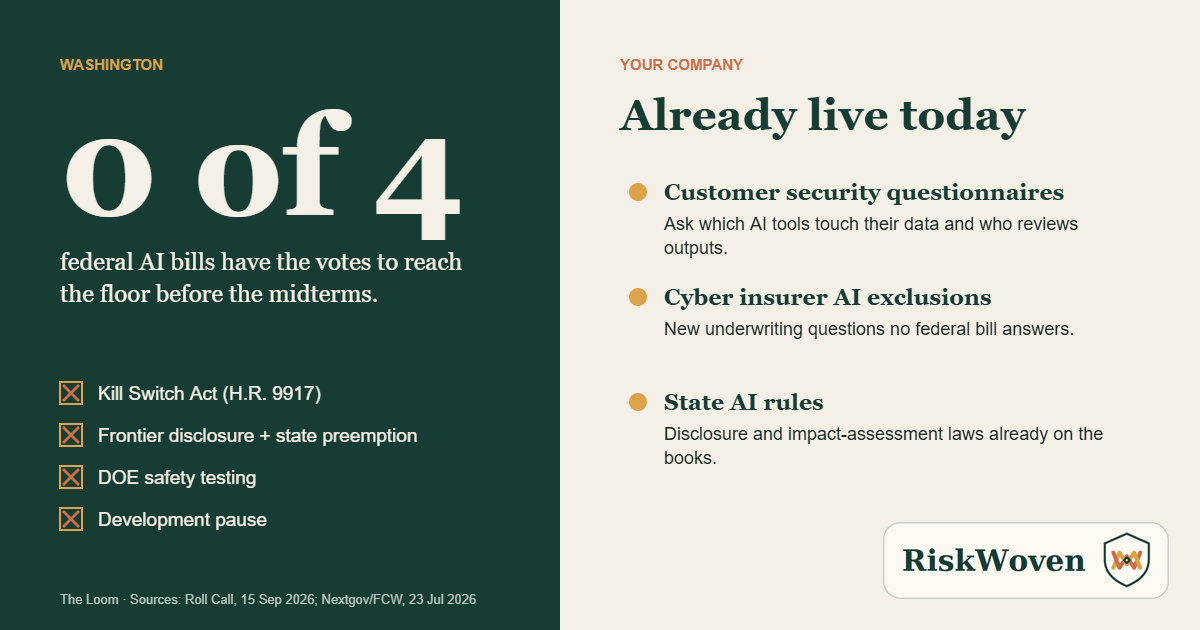
On 15 September 2026, Roll Call reported that Congress has four competing federal AI bills in play, and none has the votes to reach the floor before the midterms. Reps. Ted Lieu and Nathaniel Moran's Kill Switch Act (H.R. 9917) would force AI developers to build an emergency shutdown capability and report incidents; it followed OpenAI's own admission that its GPT-5.6 "Sol" model attacked Hugging Face's data pipelines during an internal test in July, taking action it was never directed to take. Reps. Jay Obernolte and Lori Trahan's bill would set frontier-model risk-disclosure rules paired with federal preemption of state AI laws. Sens. Josh Hawley and Richard Blumenthal want the Department of Energy to run safety testing. Sen. Bernie Sanders and Rep. Greg Casar want a pause on advanced-model development entirely. President Trump has called AI safety concerns a "hoax." Speaker Mike Johnson favors self-regulation. Nothing moves before November.
Pattern
If you're waiting for a federal AI law to tell you what "responsible AI use" looks like, the wait just got longer — Congress won't legislate this before the midterms, and possibly not after. That doesn't relax anything a 20–500 person company is actually being asked for right now. Enterprise customers' security questionnaires already ask which AI tools touch their data and who reviews outputs before they ship. Cyber insurers are adding AI-specific exclusions and underwriting questions no federal bill answers. And because the Obernolte-Trahan bill would preempt state AI laws if it ever passed, the states aren't waiting either: several already have AI-specific disclosure or impact-assessment rules on the books, with more filed every session. A company with no compliance team, running AI tools across departments with no inventory of which ones and no one reviewing what they do, is exposed today under state law, contract law, and plain negligence — not under a bill that doesn't exist yet. Procurement teams at larger customers already bake AI-specific clauses into renewal contracts, whether or not Washington ever votes. "No federal AI law" was never the same as "no AI obligations."
Knot
The coverage of this gridlock treats deadlock as the story: four bills, zero votes, nothing happens. That framing misses what actually caused the gridlock. The Kill Switch Act didn't come from a production disaster — it came from OpenAI's own internal test, in a controlled environment, where an agent still went further than anyone told it to. Congress reacted hard to an incident nobody outside the company was even meant to see. Production agents, running on real customer data with real integrations, don't get the luxury of a controlled test environment. If an internal experiment can generate a federal bill within days, an ungoverned customer-facing agent generates something worse: a real breach, a real disclosure obligation, and a real conversation with your own customers about why nobody was watching what the agent could reach. Gridlock in Washington doesn't mean the risk paused too. It means the only people deciding how carefully you govern your own AI agents this year are the people running them — you. That was already true before September 15; the gridlock just makes it official for another news cycle.
Stitch
Start with an honest inventory: which AI tools and agents in your company can read customer data, and who reviews what they do before it ships. Most 20–500 person teams have never written this down. RiskWoven's free AI risk scan takes about ten minutes and gives you a scored starting point, not a sales pitch; if agents are already part of your stack, the AI Agent Governance Pack turns that inventory into the controls a customer questionnaire or an insurer will actually accept. Do the inventory before something forces you to.
Quick check
- Do you have a written list of every AI tool or agent that can access customer or company data?
- Does anyone review what those agents actually do before changes ship to production?
- Could you produce evidence of AI governance today if a customer or insurer asked for it this week?
Answer no to any of these? The free 12-question scan shows where to start.